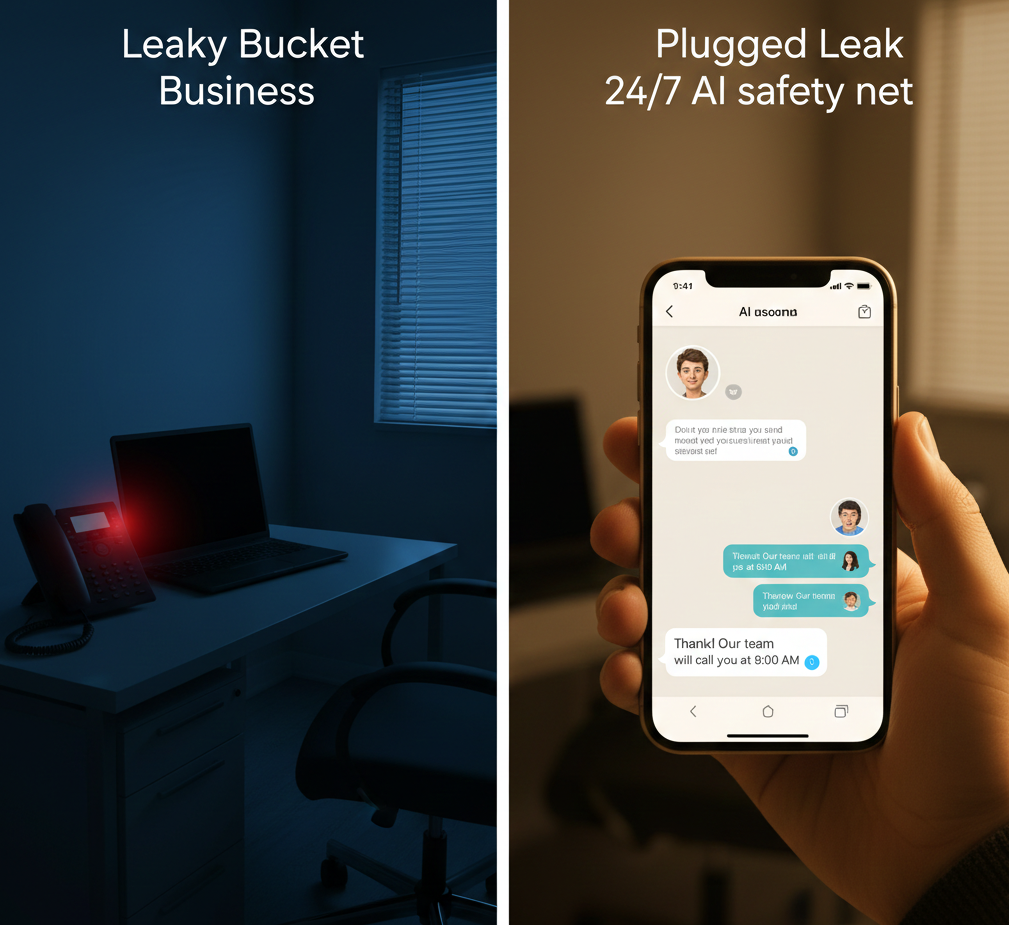

The Robot Receptionist: Why Local Service Businesses Are Winning with AI Chatbots
If you run a local service business – plumbing, HVAC, electrical, cleaning, landscaping, pest control – you’ve probably felt this pain:
You’re flat out on a job. Hands covered in grime, up a ladder, under a sink, or halfway through an install. Your phone rings. Then rings again. Then pings with a website enquiry.
You know those are potential customers…
You also know you can’t stop every five minutes to answer.
So you do what every busy owner does:
You let it go to voicemail and tell yourself you’ll catch up tonight.
By the time you get back to them?
They’ve already booked someone else.
That’s the Leaky Bucket problem: you’re constantly pouring new leads in at the top (ads, referrals, Google, social)…
…but you’re leaking money out the bottom with missed calls and slow responses.
AI chatbots – what I call the “Robot Receptionist” – are how smart local operators are quietly fixing that leak.
Speed Wins: The Harsh Reality Behind Missed Calls
Here’s a statistic that should make every local business owner sit up:
78% of customers buy from the business that responds first.
Not the cheapest.
Not the one with the fanciest website.
Not even the one with the best reviews.
The one that responds first.
In an on-demand world, people don’t want to “submit a form and wait.” They want:
- A fast answer
- A sense that someone’s listening
- A clear next step
If your phone goes to voicemail and your inbox sits unanswered for hours, here’s what actually happens:
- A prospect searches “plumber near me” or “emergency AC repair”.
- They click the top 3–5 results.
- They contact all of them – web form, click-to-call, Facebook message.
- The first one who responds with a helpful answer and a clear way to book… wins.
Everyone else? Never hears back.
So the problem for most local service businesses isn’t visibility – it’s responsiveness.
You don’t need more leads.
You need to stop losing the ones you’re already getting.
Meet Your Robot Receptionist
Now imagine this instead.
It’s 10:47 pm. You’re asleep.
A stressed homeowner discovers a burst pipe, jumps on their phone, and lands on your website.
They see a friendly chat bubble in the corner of the page:
“Hi, I’m your virtual assistant. Need help with a plumbing or leak emergency? I can grab a few details so our team can help first thing.”
They click.
Within seconds, your AI chatbot:
- Asks what’s wrong
- Confirms they’re in your service area
- Captures their name, phone, and email
- Asks if they have photos/video to upload
- Logs it straight into your CRM or sends it to your inbox
By the time you wake up, you have:
- A fully qualified emergency lead
- Contact details
- Job type
- Suburb/postcode
All queued, ready for a quick morning call and booking.
No missed call.
No guesswork.
No race to respond – because your Robot Receptionist already did.
That’s the power of a simple website chatbot, configured properly for a local service business.
What a Good AI Chatbot Actually Does (And Doesn’t Do)
This isn’t some creepy robot trying to replace you.
Done right, your Robot Receptionist has one job:
Catch and qualify leads while you’re busy or offline.
Here’s what it should do for a local service business:
- Greet visitors instantly
- “Hey there! Looking for help with plumbing, heating, or cooling? I can help you get booked in.”
- Ask 3–5 smart qualifying questions
- “What problem are you having today?”
- “Is this urgent (today/next 24 hours) or can it wait?”
- “What suburb/postcode are you in?”
- “What’s the best number to reach you on?”
- Give simple, honest expectations
- “We’re currently offline, but I’ve logged your details for priority contact between 7–8am tomorrow.”
- “For emergency visits tonight, our call-out fee starts at $X. Want us to call you with availability?”
- Hand off smoothly to humans
- Sends an email/SMS notification to you or your office
- Drops the lead into your CRM or booking system
- Tags it as “Emergency”, “Quote Request”, “Maintenance”, etc.
Here’s what it shouldn’t try to do:
- Diagnose complex technical faults
- Promise exact prices or times you can’t guarantee
- Pretend to be you personally
Think of it as a calm, friendly gatekeeper that:
- Makes customers feel heard
- Filters out tyre-kickers
- Lines up the right jobs for you to close
Industry Deep Dive: A Plumber Who Plugged the Leak
Let’s walk through a realistic example.
The Business
“ClearFlow Plumbing” is a 3-person plumbing company serving a metro area.
Before AI:
- Most work came from Google Local and word-of-mouth.
- During busy periods, they were missing 20–30% of calls.
- Website enquiries were hit and miss – some days none, some days 3–4. Responses often took hours.
- After-hours emergencies? People would call, get voicemail, and move on.
The owner, Matt, knew there was money slipping through the cracks but didn’t want a full-time receptionist and didn’t like call-answering services. He also hated the idea of “bots” annoying his customers.
The Setup
We helped Matt add a simple AI chatbot – his Robot Receptionist – to his website.
We trained it on:
- His service areas and suburbs
- Core services (blocked drains, hot water, burst pipes, gas leaks, renovations)
- Typical price ranges (not exact quotes)
- Working hours and emergency call-out rules
- His tone of voice: friendly, plain-English, no jargon
The chatbot’s core flow looked like this:
- “What’s going wrong today? Blocked drain, no hot water, leak, or something else?”
- “Where are you located? (Suburb or postcode)”
- “Is water actively leaking or flooding right now?”
- “Can you share your name and mobile number so our plumber can call you back?”
- “We’ve got your details – you’ll get a call within [X time window]. In the meantime, here’s what you can safely do…”
The First 60 Days
1. After-hours lead capture exploded
In the first two months:
- 83 after-hours visitors opened the chat
- 39 left full contact details and job descriptions
- 27 converted into booked jobs
These were leads they were previously losing while calls went unanswered.
2. Daytime “quick questions” moved to chat
During business hours, the bot started handling repetitive questions like:
- “Do you service [suburb]?”
- “Rough idea of cost for a blocked toilet?”
- “Do you do Saturday work?”
Instead of dragging Matt off the tools or interrupting his admin person, the bot gave clear, pre-approved answers and only passed through serious job requests.
3. Revenue and sanity both improved
Within 60 days:
- Booked jobs increased by roughly 18%
- The office felt less chaotic – fewer interruption calls, more high-quality enquiries
- Response speed went from “whenever we get to it” to instant acknowledgement, human follow-up in a planned window
Matt’s words summed it up:
“Before the bot, I thought I had a ‘lead problem.’
Turned out I had a ‘we-don’t-answer-people-fast-enough’ problem.”
“But Won’t My Customers Hate Talking to a Bot?”
This is the most common fear… and it makes sense. You’ve built your business on personal service.
Here’s the twist:
Customers don’t care who answers them first.
They care that someone does.
What they hate is:
- Endless ringing
- Being dumped into voicemail
- Sending a form and hearing nothing for 24+ hours
What they like is:
- An instant “Hey, I’ve got you”
- A few clear questions
- A simple, believable next step
If your Robot Receptionist:
- Is honest (“I’m an automated assistant”)
- Is polite and straight to the point
- Doesn’t try to be cute or overly clever
…your customers will love the experience, because it feels like responsiveness, not robotics.
And remember:
The bot isn’t replacing you.
It’s protecting the human relationship by making sure prospects don’t give up and go elsewhere before you’ve had a chance to help.
Why Local Service Businesses Are Perfect for AI Chatbots
AI chatbots can work in many industries, but local service businesses are in a sweet spot because:
- Urgency is high
- Burst pipes, no heat, broken AC, power issues, pests – people want help now.
- Speed to first response = money.
- Questions are repetitive
- “Do you service this area?”
- “How soon can you come?”
- “Roughly how much does X cost?”
- Perfect for a chatbot to handle.
- Jobs are high value
- One captured job can pay for months of chatbot service.
- You can’t be on the phone all day
- You’re on the tools, driving, quoting, or managing a small team.
- A Robot Receptionist is like cloning your front desk, without the payroll.
From Leaky Bucket to Booked-Out Calendar
The big picture is simple:
- Every missed call…
- Every slow reply to a web enquiry…
- Every “I’ll get back to them tonight” that never happens…
…is a hole in your bucket.
You’re working hard to pour water (leads) in.
AI chatbots help you plug the leak.
A well-configured Robot Receptionist:
- Responds instantly 24/7
- Qualifies leads while you’re on a job or asleep
- Captures key details so you can call back with confidence
- Frees you and your team from endless repetitive questions
And the best part?
You don’t need to be “techy” to get this going. The heavy lifting is in designing the right questions, answers, and hand-off – something we walk through step-by-step in the book.
Want the Exact Blueprint?
If this idea has you thinking, “I need this yesterday,” then you’ll love what’s inside AI Is The Answer.
In Chapter 6 – “The Robot Receptionist: Automating Customer Communication”, you’ll find:
- The exact questions your chatbot should ask for local service leads
- Example scripts you can copy, paste, and tweak for your business
- A simple flow that works for plumbers, HVAC, electricians, cleaners, and more
- How to connect your chatbot to email, SMS, or your CRM so nothing slips through
If you’re tired of pouring money into marketing while leads quietly leak away through missed calls and slow replies…
See the full “Robot Receptionist” blueprint in Chapter 6 of AI Is The Answer.
Your future self – and your booked-out calendar – will thank you.